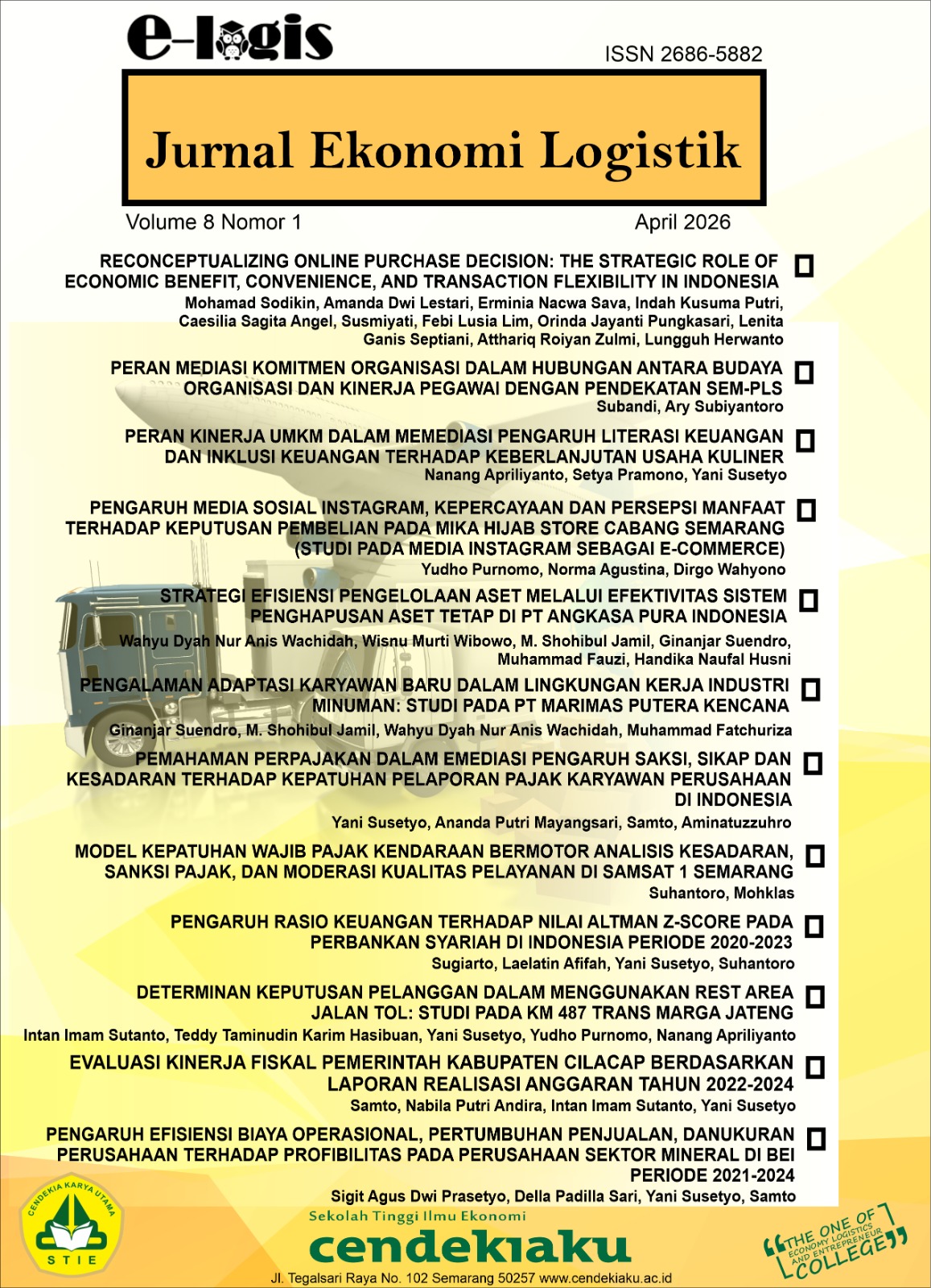
Pemahaman Perpajakan dalam Memediasi Pengaruh Sanksi, Sikap dan Kesadaran terhadap Kepatuhan Pelaporan Pajak Karyawan Perusahaan di Indonesia
DOI:
https://doi.org/10.70375/e-logis.v8i1.195Keywords:
sanctions, taxpayer attitudes, taxpayer awareness, tax understanding, tax compliance, sanksi perpajakan, sikap wajib pajak, kesadaran wajib pajak, pemahaman perpajakan, kepatuhan pelaporan SPTAbstract
Masih rendahnya tingkat kepatuhan pelaporan Surat Pemberitahuan Pajak (SPT) di Indonesia yang mendasari penelitian ini dilakukan. Hasil studi sebelumnya terdapat perbedaan terkait pengaruh kesadaran, sikap, dan sanksi terhadap kepatuhan wajib, sehingga perlu dilakukan pengujian lebih lanjut dengan memasukkan pemahaman perpajakan sebagai variabel mediasi. Tujuan penelitian ini untuk menganalisis pengaruh sanksi perpajakan, sikap wajib pajak, dan kesadaran pajak terhadap kepatuhan pelaporan SPT dengan pemahaman perpajakan sebagai variabel intervening. Pendekatan kuantitatif digunakan sebagai metode penelitian dengan melakukan survei terhadap 77 responden sebagai sampel dengan metode purposive sampling. Analisis data menggunakan Partial Least Square Structural Equation Modeling (PLS-SEM). Hasil penelitian menunjukkan sikap wajib pajak berpengaruh positif signifikan terhaap kepatuhan pelaporan SPT. Kesadaran wajib pajak tidak berpengaruh terhadap kepatuhan, tapi berpengaruh signifikan terhadap pemahaman perpajakan. Pemahaman perpajakan memediasi terhadap kepatuhan pajak.Penelitian ini memberi kontribusi penguatan peran pemahaman perpajakan sebagai mediator dalam perbedaan hasil penelitian sebelumnya untuk wajib karyawan di Indonesia.
References
Agustini, S., & Puspita, R. D. (2024). Dampak Pemahaman Pajak, Ketentuan Pajak, dan Sanksi Perpajakan terhadap Kepatuhan Wajib Pajak Orang Pribadi: Studi Kasus KPP Pratama Depok Sawangan. Inovasi, 11(1), 164–172. https://doi.org/10.32493/inovasi.v11i1.p164-172.40252
Ajzen, I. (1991). The Theory of Planned Behavior. Organizational Behavior and Human Decision Processes, 50(2), 179–211. https://doi.org/10.1016/0749-5978(91)90020-T
Alm, J., Martinez-Vazquez, J., & Torgler, B. (2019a). Tax Morale and Compliance: Review of Evidence. Journal of Economic Literature.
Alm, J., Martinez-Vazquez, J., & Torgler, B. (2019b). Tax Morale and Compliance. Journal of Economic Psychology.
Alm, J., Martinez-Vazquez, J., & Torgler, B. (2019c). Tax Morale and Tax Compliance from the Firm’s Perspective. Journal of Economic Behavior & Organization, 158, 91–105. https://doi.org/10.1016/j.jebo.2018.12.001
Anwar, M. K., Bulutoding, L., & Anwar, P. H. (2022). The Effect of Tax Knowledge and Attitude Rationality on Taxpayer Compliance. ISAFIR: Islamic Accounting and Finance Review, 2(2), 166–178. https://doi.org/10.24252/isafir.v2i2.23166
Castro, L., & Scartascini, C. (2019). Compliance spillovers across taxes: The role of penalties and detection. Journal of Economic Behavior and Organization, 164, 518–534. https://doi.org/10.1016/j.jebo.2019.06.015
Creswell, J. W., & Creswell, J. D. (2018). Research Design: Qualitative, Quantitative, and Mixed Methods Approaches (5th ed.). Sage Publications.
Hair, J. F., Hult, G. T. M., Ringle, C. M., & Sarstedt, M. (2021). A Primer on Partial Least Squares Structural Equation Modeling (PLS-SEM). Sage Publications.
Hidayat, K., Utama, M. S., & Nimran, U. (2022). The Effect of Attitude on Tax Compliance Intention Moderated by e-Filing. Journal of Financial Services Marketing. https://doi.org/10.1057/s41264-022-00171-y
Hikmah, Adi, P. H., Supramono, & Damayanti, T. W. (2021). The Nexus Between Attitude and Tax Compliance Behavior. Asian Economic and Financial Review, 11(12), 938–949. https://doi.org/10.18488/journal.aefr.2021.1112.938.949
Imelda, G., & Santioso, L. (2023). Pengaruh Tax Knowledge dan Tax Awareness terhadap Tax Compliance Wajib Pajak. Jurnal Paradigma Akuntansi, 5(1), 1–12. https://doi.org/10.24912/jpa.v5i1.22493
JOUR, T.-, AU - Slemrod, J., 2019, P.-, Enforcement, T.-T. C. and, Literature, J.-J. of E., 57, V.-, 4, I.-, 904, S.-, 954, E.-, 10.1257/jel.20181437, D.-, -, E., JOUR, T.-, AU - Lederman, L., 2018, P.-, Compliance?, T.-D. E. R. V. T., Review, J.-B. Y. U. L., 623, S.-, -, E., JOUR, T.-, … -, E. (2023). Research Design: Qualitative, Quantitative, and Mixed Methods Approaches (6th ed.). SAGE Publications. https://doi.org/-
Kamela, H. (2020). Pengaruh Kepatuhan Wajib Pajak Orang Pribadi Berdasarkan Theory Planned Of Behaviour. Journal of Applied Accounting and Taxation, 5(2), 201–209. https://doi.org/10.30871/jaat.v5i2.2141
Kirchler, E. (2020). Economic Psychology of Tax Behaviour. Cambridge University Press.
Machfuzhoh, A., & Puspanita, I. (2021). The Effect of Self Assessment and Tax Knowledge on Tax Compliance. Journal of Applied Business Taxation and Economics Research, 1(1), 66–76. https://doi.org/10.54408/jabter.v1i1.24
Mardiasmo. (2019). Perpajakan. ANDI.
Nugrahanto, A. (2021). Pengaruh Pengetahuan Perpajakan terhadap Kepatuhan Pajak pada Self Assessment System di Indonesia. Jurnal Informasi Perpajakan Akuntansi Dan Keuangan Publik, 16(1), 133–156. https://doi.org/10.25105/jipak.v16i1.8374
Putri. (2020). Kesadaran Pajak.
Rahayu, S. K. (2020). Perpajakan Indonesia: Konsep dan Aspek Formal. Salemba Empat.
Riyanto, E. A., & Ningsih, T. W. (2021). Pengaruh Kesadaran Wajib Pajak, Pengetahuan dan Pemahaman Perpajakan terhadap Kepatuhan Wajib Pajak. Jurnal Ilmiah Akuntansi Kesatuan, 9(3), 589–596. https://doi.org/10.37641/jiakes.v9i3.933
Saad, N. A. (2021). Tax Knowledge and Tax Compliance Determinants. International Journal of Economics and Financial Issues.
Sekaran, U., & Bougie, R. (2019). Research Methods for Business: A Skill-Building Approach. Wiley.
Slemrod, J. (2019). Tax Compliance and Enforcement. Journal of Economic Literature, 57(4), 904–954.
Sugiarto, R. B. F., & Syaiful. (2022). Pengaruh Pemahaman Wajib Pajak, Sosialisasi Perpajakan, Sanksi Perpajakan dan Kesadaran Wajib Pajak terhadap Kepatuhan Wajib Pajak. Journal of Culture Accounting and Auditing, 1(1). https://doi.org/10.30587/jcaa.v1i1.4247
Taing, H. B., & Chang, Y. (2020). Determinants of Tax Compliance Intention: Focus on the Theory of Planned Behavior. International Journal of Public Administration. https://doi.org/10.1080/01900692.2020.1728313
Torgler, B. (2020a). Tax Morale and Compliance: Evidence and Implications. International Tax and Public Finance.
Torgler, B. (2020b). Tax Morale and Compliance: Review of Evidence and Case Studies. International Tax and Public Finance, 27(3), 1–21. https://doi.org/10.1007/s10797-019-09589-2
Wahyuandari, W., & Talithahandari, A. (2025). The Effect of Tax Knowledge in Moderating the Connection between the Theory of Planned Behavior and Taxpayer Compliance. Jurnal Ilmiah Akuntansi Kesatuan, 13(6), 1737–1748. https://doi.org/10.37641/jiakes.v13i6.4428
Weiner, B. (1985). An Attributional Theory of Achievement Motivation and Emotion. Psychological Review, 92(4), 548–573. https://doi.org/10.1037/0033-295X.92.4.548
Zahra, M. A., & Anggraini, D. T. (2024). Understanding the Relationship Between Tax Knowledge and Compliance Under Self Assessment System. Jurnal Akademi Akuntansi, 8(2). https://doi.org/10.22219/jaa.v8i2.39384
Agustini, S., & Puspita, R. D. (2024). Dampak Pemahaman Pajak, Ketentuan Pajak, dan Sanksi Perpajakan terhadap Kepatuhan Wajib Pajak Orang Pribadi: Studi Kasus KPP Pratama Depok Sawangan. Inovasi, 11(1), 164–172. https://doi.org/10.32493/inovasi.v11i1.p164-172.40252
Ajzen, I. (1991). The Theory of Planned Behavior. Organizational Behavior and Human Decision Processes, 50(2), 179–211. https://doi.org/10.1016/0749-5978(91)90020-T
Alm, J., Martinez-Vazquez, J., & Torgler, B. (2019a). Tax Morale and Compliance: Review of Evidence. Journal of Economic Literature.
Alm, J., Martinez-Vazquez, J., & Torgler, B. (2019b). Tax Morale and Compliance. Journal of Economic Psychology.
Alm, J., Martinez-Vazquez, J., & Torgler, B. (2019c). Tax Morale and Tax Compliance from the Firm’s Perspective. Journal of Economic Behavior & Organization, 158, 91–105. https://doi.org/10.1016/j.jebo.2018.12.001
Anwar, M. K., Bulutoding, L., & Anwar, P. H. (2022). The Effect of Tax Knowledge and Attitude Rationality on Taxpayer Compliance. ISAFIR: Islamic Accounting and Finance Review, 2(2), 166–178. https://doi.org/10.24252/isafir.v2i2.23166
Castro, L., & Scartascini, C. (2019). Compliance spillovers across taxes: The role of penalties and detection. Journal of Economic Behavior and Organization, 164, 518–534. https://doi.org/10.1016/j.jebo.2019.06.015
Creswell, J. W., & Creswell, J. D. (2018). Research Design: Qualitative, Quantitative, and Mixed Methods Approaches (5th ed.). Sage Publications.
Hair, J. F., Hult, G. T. M., Ringle, C. M., & Sarstedt, M. (2021). A Primer on Partial Least Squares Structural Equation Modeling (PLS-SEM). Sage Publications.
Hidayat, K., Utama, M. S., & Nimran, U. (2022). The Effect of Attitude on Tax Compliance Intention Moderated by e-Filing. Journal of Financial Services Marketing. https://doi.org/10.1057/s41264-022-00171-y
Hikmah, Adi, P. H., Supramono, & Damayanti, T. W. (2021). The Nexus Between Attitude and Tax Compliance Behavior. Asian Economic and Financial Review, 11(12), 938–949. https://doi.org/10.18488/journal.aefr.2021.1112.938.949
Imelda, G., & Santioso, L. (2023). Pengaruh Tax Knowledge dan Tax Awareness terhadap Tax Compliance Wajib Pajak. Jurnal Paradigma Akuntansi, 5(1), 1–12. https://doi.org/10.24912/jpa.v5i1.22493
JOUR, T.-, AU - Slemrod, J., 2019, P.-, Enforcement, T.-T. C. and, Literature, J.-J. of E., 57, V.-, 4, I.-, 904, S.-, 954, E.-, 10.1257/jel.20181437, D.-, -, E., JOUR, T.-, AU - Lederman, L., 2018, P.-, Compliance?, T.-D. E. R. V. T., Review, J.-B. Y. U. L., 623, S.-, -, E., JOUR, T.-, … -, E. (2023). Research Design: Qualitative, Quantitative, and Mixed Methods Approaches (6th ed.). SAGE Publications. https://doi.org/-
Kamela, H. (2020). Pengaruh Kepatuhan Wajib Pajak Orang Pribadi Berdasarkan Theory Planned Of Behaviour. Journal of Applied Accounting and Taxation, 5(2), 201–209. https://doi.org/10.30871/jaat.v5i2.2141
Kirchler, E. (2020). Economic Psychology of Tax Behaviour. Cambridge University Press.
Machfuzhoh, A., & Puspanita, I. (2021). The Effect of Self Assessment and Tax Knowledge on Tax Compliance. Journal of Applied Business Taxation and Economics Research, 1(1), 66–76. https://doi.org/10.54408/jabter.v1i1.24
Mardiasmo. (2019). Perpajakan. ANDI.
Nugrahanto, A. (2021). Pengaruh Pengetahuan Perpajakan terhadap Kepatuhan Pajak pada Self Assessment System di Indonesia. Jurnal Informasi Perpajakan Akuntansi Dan Keuangan Publik, 16(1), 133–156. https://doi.org/10.25105/jipak.v16i1.8374
Putri. (2020). Kesadaran Pajak.
Rahayu, S. K. (2020). Perpajakan Indonesia: Konsep dan Aspek Formal. Salemba Empat.
Riyanto, E. A., & Ningsih, T. W. (2021). Pengaruh Kesadaran Wajib Pajak, Pengetahuan dan Pemahaman Perpajakan terhadap Kepatuhan Wajib Pajak. Jurnal Ilmiah Akuntansi Kesatuan, 9(3), 589–596. https://doi.org/10.37641/jiakes.v9i3.933
Saad, N. A. (2021). Tax Knowledge and Tax Compliance Determinants. International Journal of Economics and Financial Issues.
Sekaran, U., & Bougie, R. (2019). Research Methods for Business: A Skill-Building Approach. Wiley.
Slemrod, J. (2019). Tax Compliance and Enforcement. Journal of Economic Literature, 57(4), 904–954.
Sugiarto, R. B. F., & Syaiful. (2022). Pengaruh Pemahaman Wajib Pajak, Sosialisasi Perpajakan, Sanksi Perpajakan dan Kesadaran Wajib Pajak terhadap Kepatuhan Wajib Pajak. Journal of Culture Accounting and Auditing, 1(1). https://doi.org/10.30587/jcaa.v1i1.4247
Taing, H. B., & Chang, Y. (2020). Determinants of Tax Compliance Intention: Focus on the Theory of Planned Behavior. International Journal of Public Administration. https://doi.org/10.1080/01900692.2020.1728313
Torgler, B. (2020a). Tax Morale and Compliance: Evidence and Implications. International Tax and Public Finance.
Torgler, B. (2020b). Tax Morale and Compliance: Review of Evidence and Case Studies. International Tax and Public Finance, 27(3), 1–21. https://doi.org/10.1007/s10797-019-09589-2
Wahyuandari, W., & Talithahandari, A. (2025). The Effect of Tax Knowledge in Moderating the Connection between the Theory of Planned Behavior and Taxpayer Compliance. Jurnal Ilmiah Akuntansi Kesatuan, 13(6), 1737–1748. https://doi.org/10.37641/jiakes.v13i6.4428
Weiner, B. (1985). An Attributional Theory of Achievement Motivation and Emotion. Psychological Review, 92(4), 548–573. https://doi.org/10.1037/0033-295X.92.4.548
Zahra, M. A., & Anggraini, D. T. (2024). Understanding the Relationship Between Tax Knowledge and Compliance Under Self Assessment System. Jurnal Akademi Akuntansi, 8(2). https://doi.org/10.22219/jaa.v8i2.39384